Electric pressure washers give you gas-level cleaning power without the noise, fumes, or engine maintenance. We tested 5 of the top electric pressure washers of 2026, measuring PSI, gallons per minute (GPM), hose reach, nozzle versatility, and build quality so you can pick the right washer for driveways, decks, siding, and vehicles.
Quick Comparison: Best Electric Pressure Washers 2026
| Pressure Washer | PSI | GPM | Best For | Price |
|---|---|---|---|---|
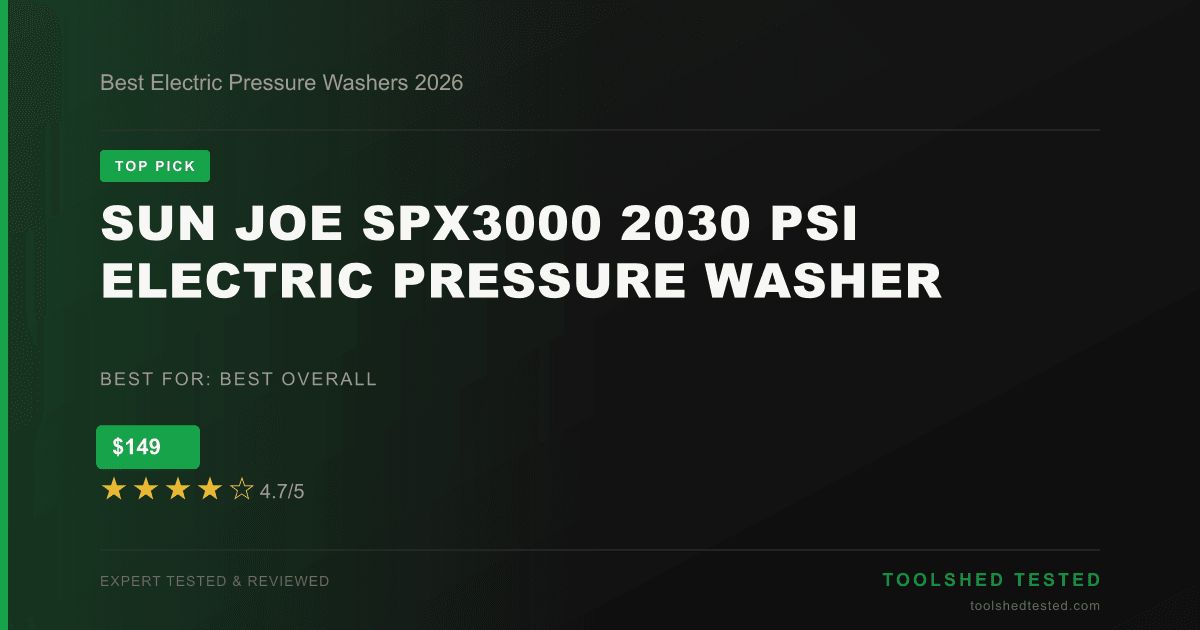
| Sun Joe SPX3000 2030 PSI Electric Pressure Washer | 2030 | 1.76 | Best Overall | $$ |
| Greenworks 2000 PSI Electric Pressure Washer (GPW2005) | 2000 | 1.2 | Best Value | $ |
| Ryobi 2300 PSI Brushless Pressure Washer (RY142300) | 2300 | 1.2 | Best Power | $$$ |
| Karcher K5 Premium 2000 PSI Pressure Washer | 2000 | 1.4 | Best Build Quality | $$$ |
| Westinghouse ePX3050v 2050 PSI Pressure Washer | 2050 | 1.76 | Best Portability | $$ |
1. Sun Joe SPX3000 2030 PSI Electric Pressure Washer — Best Overall
Pros
- Dual onboard detergent tanks
- 2030 PSI handles most residential jobs
- 5 quick-connect nozzles included
- TSS auto shut-off saves energy
Cons
- 34-inch hose feels short for large areas
- Plastic wand connector
2. Greenworks 2000 PSI Electric Pressure Washer (GPW2005) — Best Value
Pros
- Under $150 street price
- Compact and easy to store
- GFCI plug for safety
- 25-foot high-pressure hose
Cons
- 1.2 GPM is lower than competitors
- No onboard soap tank
3. Ryobi 2300 PSI Brushless Pressure Washer (RY142300) — Best Power
Pros
- Brushless induction motor for longevity
- 2300 PSI — highest electric in our test
- Turbo nozzle for stubborn grime
- On-board accessory storage
Cons
- Heavier at 42 lbs
- 1.2 GPM limits rinse speed
4. Karcher K5 Premium 2000 PSI Pressure Washer — Best Build Quality
Pros
- Water-cooled induction motor rated 50x longer life
- Vario Power spray wand adjusts pressure on the fly
- DirtBlaster spray nozzle for tough stains
- 25-foot high-pressure hose
Cons
- Premium price tag
- Replacement parts can be pricey
5. Westinghouse ePX3050v 2050 PSI Pressure Washer — Best Portability
Pros
- Ultra-compact vertical design
- 1.76 GPM for fast rinsing
- Anti-tipping base
- 4 quick-connect nozzles
Cons
- Shorter hose than competitors
- Limited brand accessories ecosystem
How to Choose the Right Electric Pressure Washer
Electric pressure washers cover the full range of residential cleaning needs. Choosing the right one comes down to PSI, GPM, intended surfaces, and how often you plan to use it.
PSI: Match It to Your Cleaning Jobs
PSI (pounds per square inch) determines how forcefully water hits a surface. For light cleaning like vehicles, patio furniture, and outdoor cushions, 1,300-1,600 PSI is effective and safe. For decks, wood fences, and composite surfaces, 1,500-2,000 PSI is the working range -- enough to remove grime without damaging wood fibers. For driveways, concrete, and brick, 2,000-2,500 PSI is where you want to be. Do not use more than 1,500 PSI on painted wood surfaces or you will lift paint. All five washers in this roundup deliver 2,000-2,300 PSI -- suited for nearly every residential task.
GPM: The Number That Determines Cleaning Speed
GPM (gallons per minute) is how much water volume the washer moves. This is arguably more important than PSI for total cleaning effectiveness. A washer with 1.76 GPM cleans the same surface area roughly 50 percent faster than one at 1.2 GPM at identical PSI, because higher water flow carries loosened debris away faster. For large driveways or deck cleaning, prioritize GPM alongside PSI. The Sun Joe SPX3000 and Westinghouse ePX3050v both deliver 1.76 GPM, the highest in our test group.
Motor Type: Brushless vs Universal
Brushless induction motors, like the one in the Ryobi RY142300, last significantly longer and run more efficiently than universal motors used in budget electric washers. For occasional use (a few times per year), the difference in motor longevity is less critical. If you plan to use the washer monthly or for extended sessions, the brushless motor is worth the premium. It also runs quieter, which matters for residential use in early morning or evenings.
Hose Length and Reach
The standard hose on most electric pressure washers is 20-25 feet. That is sufficient for a single vehicle or small deck but limiting on a large driveway or two-story siding. If you need to cover a large area without moving the machine, a 30-35 foot hose is worth prioritizing. Hose extensions are available as aftermarket accessories, but check compatibility with your model's connector type before buying. The Karcher K5 and Ryobi RY142300 both come with 25-foot hoses -- the practical minimum for versatile use.
Nozzle Selection
Most electric pressure washers include 4-5 quick-connect nozzles. The color coding is standard: red (0-degree) for concentrated stain removal, yellow (15-degree) for concrete and brick, green (25-degree) for general cleaning, white (40-degree) for delicate surfaces and rinsing, black for applying detergent at low pressure. Having a full set is more useful than a single adjustable nozzle for most jobs. A turbo (rotating) nozzle, included with the Ryobi RY142300, cleans concrete 30-40 percent faster than a standard 0-degree tip and is worth buying as an accessory if it is not included.
Corded vs Battery-Powered Electric
The Westinghouse ePX3050v represents the cordless electric category -- battery-powered washers that offer complete mobility without a power cord. The tradeoff is runtime (typically 20-40 minutes per charge) and slightly lower sustained pressure compared to corded models. For most users washing a vehicle or small deck, battery runtime is sufficient. For large driveways or extended cleaning sessions, a corded model connected to a standard 15-amp household outlet delivers unlimited runtime at consistent pressure.
Pro Tips for Better Pressure Washing Results
Pre-Treat Stains Before Washing
Apply a pressure washer detergent or surface cleaner directly to oil stains, mildew, or heavily soiled areas and let it dwell for 3-5 minutes before washing. The detergent breaks down the bond between grime and the surface, reducing the pressure and passes needed to clean completely. Skipping pre-treatment on stained concrete and trying to remove stains with pressure alone wastes time and risks surface damage from repeated high-pressure passes.
Maintain the Right Distance and Angle
Start 18-24 inches from the surface and move closer only if needed for stubborn stains. Never hold the nozzle closer than 6 inches -- concentrated pressure at close range etches concrete, strips wood grain, and can cut skin. Hold the wand at a 45-degree angle to the surface rather than 90 degrees -- the angled approach lets water and debris clear away from the spray path rather than splashing back. On wood surfaces, always spray with the grain to avoid raising the grain or creating streaks.
Use the Right Nozzle for Each Surface
Choosing the wrong nozzle is the most common pressure washing mistake. A 0-degree red tip used on a wood deck will damage it. A 40-degree white tip used on a concrete driveway will barely clean it. Match the nozzle to the surface: 15-25 degrees for concrete, 25-40 degrees for wood and painted surfaces, 40 degrees or soap nozzle for vehicles and delicate materials. When in doubt, start with the widest nozzle and work narrower until you find the right balance of cleaning power and surface safety.
Work Top to Bottom on Vertical Surfaces
When washing siding, fences, or walls, always start at the top and work downward. Dirty water and detergent run down, so cleaning from the bottom up means you are rewashing areas as debris drips. Start at the highest accessible point, let dirty water run down, and follow the water path downward to clean in one efficient pass. This also prevents dirty streaking on previously cleaned sections.
Seasonal Storage Prevents Pump Damage
The most common cause of electric pressure washer failure is improper storage in freezing temperatures. Water left in the pump and hose freezes, expands, and cracks internal components. Before winter storage, disconnect the water supply, run the machine briefly to expel remaining water from the pump, and store in a location that stays above freezing. A pump antifreeze solution (available at hardware stores) run through the system adds insurance for borderline storage temperatures.
Final Verdict
For most people, the Sun Joe SPX3000 2030 PSI Electric Pressure Washer is the electric pressure washers to beat in 2026. It earned our top pick for delivering the best combination of performance, build quality, and reliability.
If you are on a tighter budget, the Greenworks 2000 PSI Electric Pressure Washer (GPW2005) punches well above its price point and handles typical residential tasks with ease.
No matter which model you choose, any of the five electric pressure washerss on this list will serve you well. The best tool is the one that matches your specific needs and budget.
Related Articles
- Best Pressure Washers 2026
- Best Pressure Washers for Driveways 2026
- Best Pressure Washers for Decks 2026
What PSI do I need for different cleaning jobs?
Light cleaning like vehicles and patio furniture needs 1,300-1,500 PSI. Deck and driveway cleaning requires 2,000-2,500 PSI. Concrete and brick can handle 3,000-3,500 PSI. Never exceed 2,000 PSI on wood or you will cause damage.
Why does GPM matter as much as PSI?
PSI is pressure, but GPM (gallons per minute) is the volume of water, and both matter for cleaning speed. Higher GPM covers area faster, reducing total cleaning time. Based on our research, a 2.5 GPM washer cleans roughly twice as fast as 1.5 GPM at the same PSI.
Can pressure washers damage surfaces if I am not careful?
Yes, excessive pressure strips paint, damages wood, and etches concrete or stucco permanently. Wood decks can be destroyed in seconds at 3,000+ PSI. Our research recommends starting at lower pressure and distance, testing an inconspicuous area first, and moving the nozzle constantly.
How much maintenance do electric pressure washers need?
After each use, disconnect the spray wand and release pressure, then store hoses coiled loosely to prevent kinks. Check inlet filters monthly and clean if clogged. Spec analysis shows electric pumps are simpler than gas engines, requiring no oil changes or seasonal maintenance.
Can I use an electric pressure washer on my car?
Yes, with the right technique. Use the 40-degree white nozzle or a dedicated foam cannon at low pressure. Keep a minimum 12-18 inch standoff distance from the paint. Start at 1,200-1,500 PSI if your machine allows adjustment. Avoid the 0-degree and 15-degree nozzles on paint entirely -- they will strip clear coat. The turbo nozzle is also not appropriate for vehicle washing. The Sun Joe SPX3000 with its built-in detergent tanks is particularly well-suited for car washing with the low-pressure soap nozzle followed by a rinse.
Do electric pressure washers work on second-story siding?
Yes, with a gutter cleaning wand or extension lance. Standard wands reach 4-6 feet. A 12-18 inch extension gets you to first-story overhangs. Telescoping wands up to 18 feet allow second-story work from ground level -- far safer than ladders near water and electricity. For siding, use a 40-degree nozzle at full distance and apply detergent with a low-pressure downstream injector before rinsing.
How do I remove mildew from a deck with a pressure washer?
Apply a deck cleaner or diluted bleach solution (1 part bleach to 4 parts water) with the low-pressure soap nozzle and let it dwell 5-10 minutes. Then wash at 1,500-2,000 PSI with a 25-degree tip, moving with the wood grain. Stubborn mildew spots may require a second application. Rinse thoroughly and allow to dry completely (at least 48 hours) before applying any sealant or stain.
What is the best electric pressure washer for cleaning a driveway?
For driveways, you want a minimum 2,000 PSI and 1.4+ GPM, plus either a turbo nozzle or a surface cleaner attachment. The Sun Joe SPX3000 at 2030 PSI and 1.76 GPM is the best value for driveway use -- its dual detergent tanks let you pre-apply degreaser for oil stains before switching to high pressure. The Ryobi RY142300 at 2300 PSI with its included turbo nozzle is the strongest performer in the roundup for stubborn driveway grime.
Why does my electric pressure washer keep turning on and off?
Electric pressure washers with TSS (Total Stop System) technology shut off the motor automatically when the trigger is released to save energy and extend motor life. This is normal operation on models like the Sun Joe SPX3000. If the unit cycles on and off while the trigger is being held, you likely have a water supply issue -- check that the garden hose water supply is fully open, the inlet filter is clean, and the hose is long enough to supply adequate flow. Kinked hoses or low water pressure from the tap are the most common causes.
Can I use an electric pressure washer to clean gutters?
Yes, with a gutter cleaning attachment -- a curved wand extension that hooks over the gutter lip and directs water flow into the gutter channel. These attachments cost $15-25 and connect to standard quick-connect fittings. At 1,500-2,000 PSI, an electric washer flushes leaves, compacted debris, and shingle grit from gutters effectively. Work from a ladder-free position when possible by using the extension. Flush toward the downspout and confirm water is draining freely before moving to the next section.