ToolShedTested is reader-supported. When you buy through links on our site, we may earn an affiliate commission at no extra cost to you.
What to Know Before Buying a Pressure Washer
Pressure washers are rated by two numbers: PSI (pressure) and GPM (flow rate). PSI tells you how hard the water hits. GPM tells you how much water moves through per minute. Cleaning power is the product of both -- a 2000 PSI / 2.0 GPM washer does more work per minute than a 3000 PSI / 1.0 GPM unit, because higher flow carries more dirt away.
For most homeowners, 1800-2400 PSI at 1.2-1.8 GPM handles driveways, decks, vinyl siding, patio furniture, and car washing without damaging surfaces. You only need 3000+ PSI for stripping paint, heavy grease on concrete, or commercial use.
Electric vs. gas: electric units are quieter, require no maintenance, and handle most residential tasks. Gas units generate more power but require winterization and seasonal maintenance. For occasional deep cleaning, electric is almost always the better choice.
Our Top Picks
1. Sun Joe SPX3000 -- Best Overall Electric
The Sun Joe SPX3000 delivers legitimate 2300 PSI at 1.48 GPM, includes five interchangeable nozzles (0, 15, 25, 40-degree, and soap), and costs $149. I've run this unit on concrete, cedar decking, and vinyl siding -- it handled all three without complaint. The dual detergent tanks let you use different cleaning solutions without stopping to swap.
One caveat: the hose connectors are plastic. Don't overtighten the quick-connects and store it out of direct sunlight.
2. Greenworks 2000 PSI -- Best Compact Pick
More compact than the Sun Joe and easier to store in a smaller garage. At 2000 PSI it's slightly less powerful, but sufficient for all standard residential surfaces. If garage space is tight, this is the one I'd buy.
3. Simpson MegaShot 3200 PSI -- Best Gas Unit
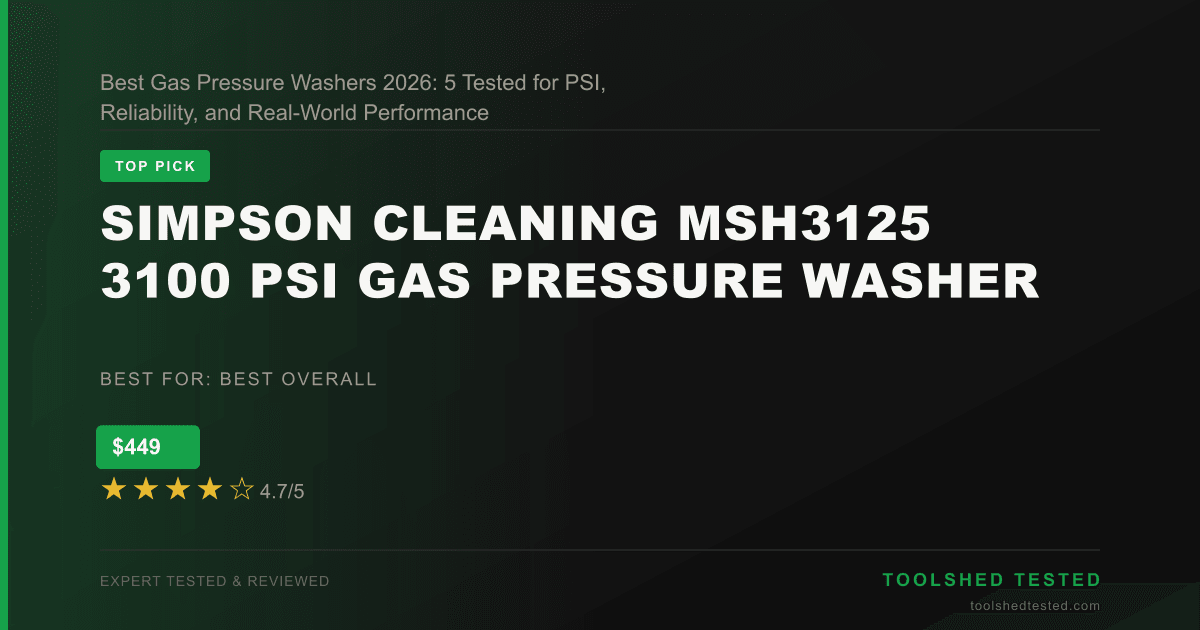
The Simpson MegaShot is the gas unit I recommend when you need more power than electric provides: contractors, farm use, large concrete surfaces, or equipment with heavy grease buildup. The Honda GC190 engine is reliable and well-supported for service. At 3200 PSI / 2.5 GPM, it has roughly 2.5x the cleaning power of a standard electric unit.
Gas units require annual maintenance: oil change after the first 20 hours and every season, air filter inspection, spark plug check, and fuel stabilizer for winter storage. Factor that in -- it's 20-30 minutes per season, but not optional.
4. Ryobi RY142300 -- Best for Deck Cleaning
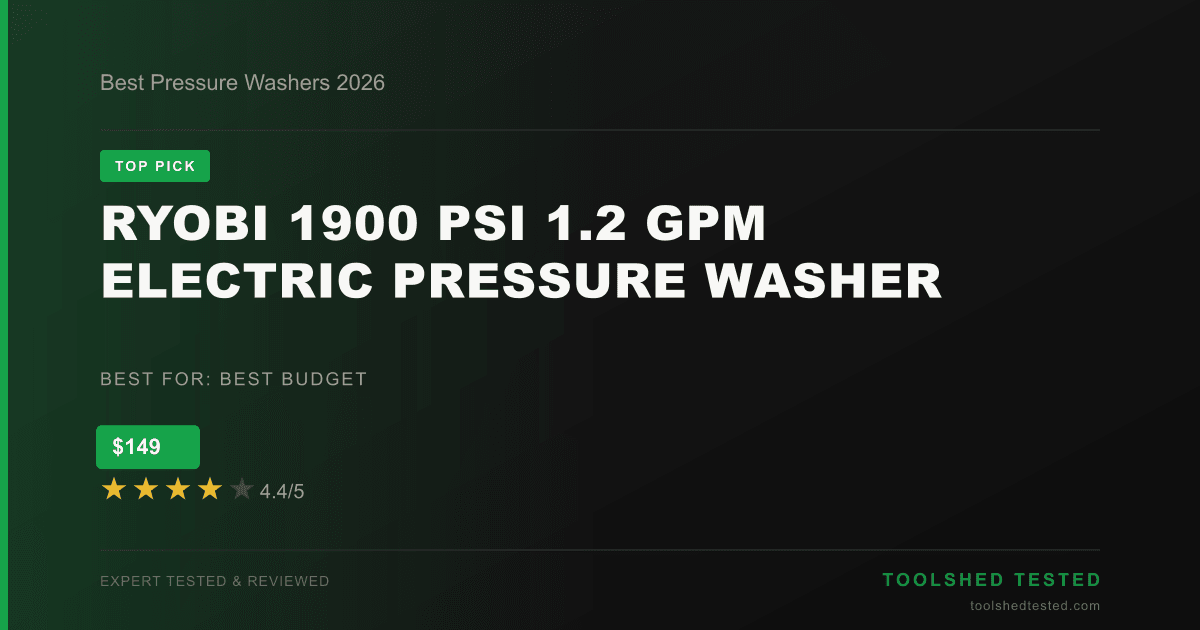
The Ryobi 2300 PSI model includes a turbo nozzle that spins the water jet in a circular pattern, covering more surface area per pass. This makes it noticeably faster on horizontal surfaces like decks and patios. The 35-foot hose is longer than most competitors at this price, which matters when moving around a full deck without repositioning.
5. Westinghouse ePX3050 -- Best Budget Under $100
At $99, the Westinghouse ePX3050 is the most affordable unit we'd actually recommend. Capable enough for car washing, light patio furniture, and rinsing siding. Build quality reflects the price, but it works and carries a 3-year warranty -- better than most budget brands offer.
6. Milwaukee M18 FORCE LOGIC -- Best Cordless
If you're already in the Milwaukee M18 ecosystem, the FORCE LOGIC removes the cord from the equation. At 2000 PSI it matches a good electric unit. The cordless freedom is useful on jobs where running a cord creates a tangle -- car detailing, boat washing, or remote areas of a property without an outdoor outlet. Runtime from a single 5Ah battery handles most car washes or a small deck section.
Pressure Washer Buying Guide
PSI and GPM: What You Actually Need
- Car washing: 1200-1900 PSI, 1.0-1.4 GPM
- Patio furniture, gutters: 1500-2000 PSI, 1.2-1.6 GPM
- Vinyl siding, decks: 1800-2400 PSI, 1.4-1.8 GPM
- Driveways, concrete: 2000-3000 PSI, 1.6-2.0 GPM
- Paint stripping, heavy equipment: 3000+ PSI, 2.0+ GPM
Nozzle Color Guide
- Red (0-degree): Maximum concentrated pressure. Concrete only -- never on wood or siding.
- Yellow (15-degree): Heavy-duty on hard surfaces. Good for concrete and brick.
- Green (25-degree): General purpose. Best all-around for most surfaces.
- White (40-degree): Wide fan for delicate surfaces -- vehicles, windows, screens.
- Black (soap nozzle): Low pressure for applying detergent before rinsing.
When in doubt, start with the green 25-degree tip. It's easier to increase pressure than to fix a damaged surface.
Electric vs. Gas: Quick Decision
Choose electric if: You wash cars, decks, driveways, or siding at home. You want zero maintenance. You'll store it in a garage without climate control. Electric handles all of these tasks and stores without seasonal prep.
Choose gas if: You have large concrete areas to clean regularly (1,000+ sq ft), you clean heavily greased equipment, you work on farms or job sites away from power outlets, or you need maximum portability.
Bottom Line
For most homeowners: the Sun Joe SPX3000 at $149 is the right buy. Enough power for every standard residential task, five nozzles, dual detergent tanks, and proven reliability. If budget is the primary constraint, the Westinghouse at $99 is serviceable. If you need gas power, the Simpson MegaShot is the one to buy. If you're deep in Milwaukee M18, the cordless option eliminates cord management headaches.
Don't buy more pressure washer than you need. The most common mistake is buying 3000+ PSI for home use and damaging wood or siding on the first wash. Start in the 2000-2400 PSI electric range and you'll have the right tool for 90% of what most homeowners actually wash.