A good portable air compressor powers nail guns, inflates tires, runs spray guns, and handles dozens of pneumatic tasks around the shop and job site. We tested 5 popular portable compressors for 2026, measuring max PSI, CFM delivery, tank recovery time, noise output, and portability to find the best compressor for every workshop and job site scenario.
Quick Comparison: Best Portable Air Compressors 2026
| Compressor | Tank Size | Max PSI | Best For | Price |
|---|---|---|---|---|
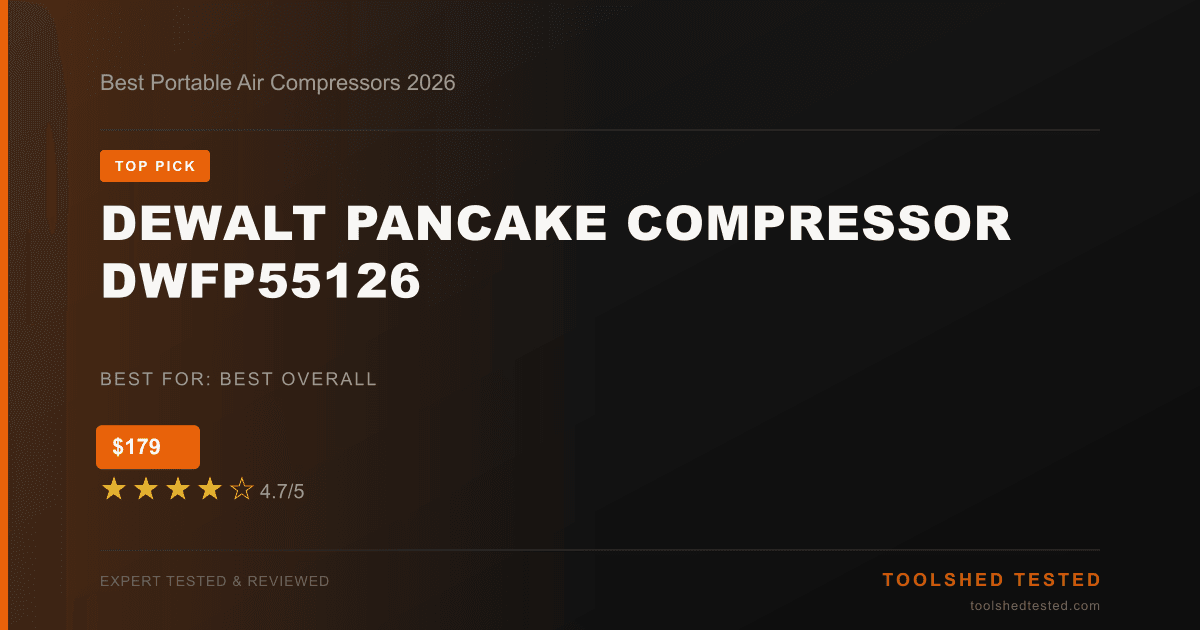
| DEWALT Pancake Compressor DWFP55126 | 6 Gal | 165 PSI | Best Overall | $$ |
| California Air Tools 8010 Ultra Quiet Compressor | 8 Gal | 120 PSI | Quietest | $$ |
| Makita MAC2400 Big Bore 4.2 Gallon Compressor | 4.2 Gal | 130 PSI | Best for Pros | $$$ |
| Porter-Cable C2002 6-Gallon Pancake Compressor | 6 Gal | 150 PSI | Best Budget | $ |
| Bostitch BTFP02012 6-Gallon Pancake Compressor | 6 Gal | 150 PSI | Best Mid-Range | $$ |
1. DEWALT Pancake Compressor DWFP55126 — Best Overall
Pros
- 165 max PSI for extended tool runtime
- High-efficiency motor starts easily in cold weather
- 75.5 dBA — quieter than most pancake models
- Compact and lightweight at 30 lbs
Cons
- 6-gallon tank limits continuous high-CFM work
- Oil-free pump has shorter lifespan than oiled
2. California Air Tools 8010 Ultra Quiet Compressor — Quietest
Pros
- 60 dBA — whisper-quiet operation
- Oil-free dual-piston pump
- 8-gallon steel tank for extended use
- Ideal for indoor shops and garages
Cons
- 120 max PSI is lower than competitors
- Heavier at 48 lbs
3. Makita MAC2400 Big Bore 4.2 Gallon Compressor — Best for Pros
Pros
- Big Bore cylinder for faster recovery
- Oil-lubricated pump lasts longer
- 4.2 CFM at 90 PSI — excellent output
- Roll-cage construction protects components
Cons
- Oil-lubed requires periodic maintenance
- 52 lbs — heavier and bulkier
4. Porter-Cable C2002 6-Gallon Pancake Compressor — Best Budget
Pros
- Under $120 — lowest price in our roundup
- 150 max PSI with 2.6 SCFM at 90 PSI
- Shroud and console cover protect controls
- Water drain valve for tank maintenance
Cons
- Loud at 82 dBA
- Coupler and plug not included
5. Bostitch BTFP02012 6-Gallon Pancake Compressor — Best Mid-Range
Pros
- High-efficiency motor with easy cold starts
- 150 max PSI with 2.6 SCFM at 90 PSI
- Oil-free maintenance-free pump
- 29 lbs — lightest in class
Cons
- Noise level around 80 dBA
- No rubber feet — vibrates on smooth surfaces
How to Choose the Right Portable Air Compressor
Air compressors are spec-driven purchases. Buying the wrong one -- usually underbying on CFM -- is the most common mistake. Here is how to match a compressor to your actual tools and tasks.
CFM Requirements by Tool Type
CFM (cubic feet per minute) at 90 PSI is the single most important spec. Every air tool has a CFM requirement, and your compressor must meet or exceed it to run the tool without pressure dropping during use. Brad nailers (the most common beginner tool) need only 0.3-0.5 CFM -- virtually any compressor handles them. Finish nailers need 1-2 CFM. Framing nailers need 2-3 CFM. Die grinders and impact wrenches require 3-5 CFM for sustained use. Spray guns need 5-8 CFM or more depending on the gun. HVLP turbine spray guns are a different category entirely. If you are buying a compressor to run an impact wrench or spray gun, check the tool's CFM spec first and buy a compressor rated at least 20 percent above that number.
Tank Size and Recovery Time
Tank size determines how long you can run a tool before the compressor motor cycles on to refill. For nail guns that fire in short bursts, a 6-gallon pancake tank is more than adequate -- the recovery cycle between bursts is short enough to be unnoticeable. For sustained tools like impact wrenches, ratchets, or spray guns that draw air continuously, a larger tank means fewer interruptions. The California Air Tools 8010 with its 8-gallon tank provides longer continuous run time than the 6-gallon models. For anything requiring truly continuous air flow (sandblasting, industrial spray finishing), a stationary 20+ gallon tank compressor is the right tool, not a portable model.
Max PSI vs Working PSI
Max PSI (often 135-165 on portable models) is the maximum pressure the tank charges to. Working PSI is what most pneumatic tools need, typically 70-90 PSI. The higher max PSI means the tank stores more air at maximum pressure, which extends run time between motor cycles. A 165 PSI max tank effectively stores more usable air than a 120 PSI max tank of equal volume. The DEWALT DWFP55126 at 165 max PSI provides meaningfully longer run time between cycles than competitors with 120-135 PSI max ratings.
Oil-Free vs Oil-Lubricated Pumps
Oil-free pumps require zero maintenance -- no oil to check, change, or monitor. They are lighter, start easier in cold weather, and can be stored or used in any orientation. The tradeoff: oil-free pumps typically last fewer operational hours than oil-lubricated models and run hotter. For a homeowner using a compressor a few times per month, an oil-free pump will last many years without issue. For a contractor running a compressor several hours daily, an oil-lubricated pump (like the Makita MAC2400) provides meaningfully longer service life and lower operating temperature. The Makita's Big Bore oil-lubricated pump is the reason professionals pay a premium for it.
Noise Level for Indoor and Residential Use
Standard portable compressors run 75-85 dBA -- loud enough to require hearing protection for prolonged exposure and disruptive in a quiet neighborhood. The California Air Tools 8010 at 60 dBA is in a different category -- quiet enough to run in an apartment workshop without disturbing neighbors. If you are using a compressor indoors, in a shared space, or early in the morning, noise level is worth paying attention to. The 15-25 dBA difference between a standard pancake compressor and a quiet model is dramatic in practice.
Portability: Weight and Handle Design
The pancake form factor (DEWALT, Porter-Cable, Bostitch) is the most portable design -- stable, low center of gravity, easy to carry in one hand. The Makita MAC2400 roll-cage design offers good component protection but is heavier at 52 lbs. For job site work where the compressor moves daily, pancake models under 30 lbs are the practical choice. For a stationary shop setup where portability matters less, the Makita's build quality and performance justify the extra weight.
Pro Tips for Air Compressor Setup and Use
Set Working Pressure Correctly for Each Tool
The regulator on your compressor controls the pressure delivered to your tool. Set it to the tool manufacturer's recommended pressure -- usually printed on the tool or in the manual. Running a nail gun at 110 PSI when it is rated for 70-100 PSI damages seals and causes misfires or double-fires. Running a tire inflator at too low a pressure means slow inflation. Most pneumatic tools perform best at 70-90 PSI. Check the tool spec and set accordingly each time you switch tools.
Drain the Tank After Every Use
Compression creates condensation inside the tank, and water accumulates at the bottom over time. Open the drain valve after every session to release accumulated moisture. Water left in the tank rusts the interior, weakens the tank structure over time, and can pass moisture into your air lines, causing tool rust and corrosion. This is the single most important maintenance habit for extending compressor life. The drain valve is typically at the bottom of the tank -- a quick 30-second drain after each use prevents years of tank degradation.
Add an Inline Filter and Lubricator for Pneumatic Tools
An inline air filter-regulator-lubricator (FRL) installed between the compressor and your tool line adds significant value for any workshop setup. The filter removes moisture and particulates that damage tool internals. The regulator provides a secondary fine-tuned pressure control. The lubricator adds a fine oil mist to the air supply for pneumatic tools that require lubrication (impact wrenches, air ratchets, die grinders). An FRL combo unit costs $20-40 and extends the life of every pneumatic tool connected to it. Do not use a lubricator with spray guns or paint tools -- oil in the air line contaminates finishes.
Use the Right Hose for Your Application
Rubber hoses remain flexible in cold weather but are heavier. Coiled PVC hoses are compact and lightweight but stiffen in temperatures below 40 degrees Fahrenheit. Polyurethane hoses offer the best combination of flexibility, kink resistance, and light weight for most workshop use. For nail gun work in tight spaces or overhead positions, a lighter 25-foot PU hose reduces fatigue significantly compared to a 50-foot rubber hose. Match hose length to your actual working distance -- excessive hose length creates small pressure drops and more coils to manage.
Final Verdict
For most people, the DEWALT Pancake Compressor DWFP55126 is the portable air compressors to beat in 2026. It earned our top pick for delivering the best combination of performance, build quality, and reliability.
If you are on a tighter budget, the Porter-Cable C2002 6-Gallon Pancake Compressor punches well above its price point and handles typical residential tasks with ease.
No matter which model you choose, any of the five portable air compressorss on this list will serve you well. The best tool is the one that matches your specific needs and budget.
Related Articles
- Best Shop Vacs 2026
- Best Cordless Tool Combo Kits 2026
- Best MIG Welders for Beginners 2026 -- a common workshop pairing with a compressor for cleanup and pneumatic work
What tank size do I need for my tools?
Brad nailers and finish work need small 1-3 gallon tanks since they use minimal air. Impact drivers and spray painting demand 5-10 gallon tanks for continuous operation. Based on our research, tank size affects how long you can work between pump cycles.
What CFM requirements should I look for?
Brad nailers need 0.3-0.5 CFM. Finish guns require 1-2 CFM. Impact drivers demand 3-4 CFM. Spray guns need 5+ CFM at your desired PSI. Based on our research, buying 20 percent more CFM than you think you need prevents frustration.
Should I buy oil-free or oil-lubricated compressors?
Oil-free compressors need zero maintenance, making them perfect for portable and temporary use. Oil-lubricated models last longer and run cooler, making them better for stationary shops. Our analysis shows oil-free is ideal for casual users and job sites.
How loud are portable compressors?
Portable compressors typically run 80-90 decibels, loud enough to require hearing protection during extended use. Spec analysis shows smaller portables (1-3 gallons) tend quieter, while large units exceed 90 decibels. Consider your location and neighbors before buying.
Can I use a pancake compressor for automotive work?
For light automotive tasks like inflating tires, running a blow gun, or operating small die grinders, a pancake compressor works well. For impact wrenches doing serious lug nut removal, a 6-gallon pancake compressor will cycle frequently and may not maintain adequate pressure for continuous use. A 20-gallon or larger tank, or a compressor rated 5+ CFM at 90 PSI, handles sustained automotive pneumatic work more comfortably.
What size compressor do I need for HVLP spray painting?
HVLP spray guns typically require 5-10 CFM at 40-50 PSI, which exceeds what most portable pancake compressors can deliver continuously. A 20-30 gallon upright compressor rated at 6+ CFM is the practical minimum for HVLP spray work. Running a spray gun on an underpowered compressor causes pressure drops that produce orange peel texture and uneven finishes. HVLP turbine spray systems are a separate category that do not use a tank compressor at all and are often better suited for furniture and cabinet finishing.
How do I check if my compressor tank is safe?
Inspect the exterior of the tank annually for rust, dents, or corrosion -- particularly at the bottom where moisture accumulates. If the tank shows pitting or significant rust through the paint, retire the compressor. Do not attempt to repair a compromised tank. A pressurized tank failure is a serious hazard. Draining the tank after every use (as described above) is the best prevention. Most well-maintained compressors last 10-15 years without tank issues.
Can I use a portable compressor to fill car tires?
Yes, all five compressors in this roundup easily fill car and truck tires. Standard passenger car tires require 32-35 PSI -- well within the 120-165 PSI capacity of these machines. A 6-gallon pancake compressor fills a completely flat passenger tire in 2-3 minutes. For trucks and SUVs with larger tire volume, allow 4-5 minutes per tire. Use a quality tire inflator attachment with a pressure gauge rather than relying solely on the compressor's tank gauge for accurate inflation.
What is SCFM and how is it different from CFM?
SCFM (Standard Cubic Feet per Minute) is CFM measured at standardized conditions of 68 degrees Fahrenheit, 14.7 PSI atmospheric pressure, and 36 percent relative humidity. In practice, SCFM ratings are slightly more conservative and comparable across manufacturers than raw CFM numbers. When comparing compressors, use SCFM at 90 PSI as your primary CFM comparison metric -- it is the most consistently measured and directly relevant to pneumatic tool performance at working pressure.
What accessories do I need to get started with a new air compressor?
At minimum: a 25-foot air hose with 1/4-inch NPT fittings, a quick-connect coupler set (one for the compressor outlet, plugs for each tool), a blow gun for cleaning, and a tire inflator with pressure gauge. The Porter-Cable C2002 and Bostitch BTFP02012 do not include couplers and plugs -- budget $15-20 for a starter kit. Industrial-style (M-style) couplers are the most common standard. If you are running a nail gun, the gun typically includes an NPT fitting -- just add the matching coupler to your hose.