I've built a lot of decks. In 14 years of residential construction, I'd estimate I've framed, decked, and railed somewhere north of 60 of them -- from simple 10x12 ground-level platforms to multi-level structures with built-in stairs and pergolas. In that time, I've also watched a lot of homeowners and first-timers show up at job sites or lumber yards with a cart full of tools they don't need, and completely missing the two or three they do.
So here's the honest answer to "what power tools do I need to build a deck?" -- it's a shorter list than you think, and the tools on it are more specific than most guides will tell you. This article covers the 6 tools that actually earn their keep on a deck job, with specific product picks I'd buy today if I were starting from scratch.
Disclosure: This page contains affiliate links. If you purchase through our links, we may earn a commission at no extra cost to you.
Quick Picks: Best Power Tools for Deck Building
See our top picks comparison table above for a side-by-side view of our recommended tools, ratings, and current prices.
The 6 Power Tools You Actually Need for Deck Building
Every tool on this list pulls genuine weight on a deck job. I've cut every one of these from builds where I was trying to travel light, and every time I paid for it in extra time or worse cuts. Here's what to buy, what to look for, and what I'd grab today.
1. Miter Saw -- For Precise Length Cuts on Boards and Framing
If you're only going to own one stationary cutting tool for deck work, make it a miter saw. This is how you cut deck boards to finished length, how you cut rim joists and blocking square, and how you dial in precise angles for stair stringers or angled deck ends. Trying to do all of that with a circular saw is possible -- I've done it -- but you will spend twice as long and your cuts will show it.
For deck work, here's what actually matters when choosing a miter saw:
- 10" vs 12": A 10" blade handles the vast majority of deck lumber -- 2x6, 2x8, 4x4 posts. A 12" saw adds capacity for wider stock and beam material, but it's heavier and pricier. For most residential decks, 10" is the right call.
- Sliding vs non-sliding: A sliding compound miter saw extends its crosscut capacity significantly -- a 10" slider can crosscut boards up to 12-13" wide, which matters if you're cutting 5/4 decking at a bevel or working with wide fascia boards. Non-sliding saws are more compact and often more durable, but limited in width capacity. For deck work, I prefer a slider.
- Positive stops: You'll be cutting 45s, 22.5s, and occasionally odd compound angles for stair framing. Accurate detents at common angles save you from measuring and resetting every time.
- Dust collection: Not critical outdoors, but a saw that throws less sawdust in your face is a saw you'll use more comfortably all day.
Top Pick: DeWalt DWS779 12" Sliding Compound Miter Saw
The DWS779 is the saw I've recommended to more people than any other single tool in the last five years, and I still would today. It's a 15-amp, 12-inch sliding compound saw with a 3-5/8" vertical cut capacity and excellent positive stops throughout its range. The dual-bevel adjustment is smooth, the fence is solid, and the XPS cross-cut positioning system (a shadow line rather than a laser) is more accurate and reliable than most lasers I've used. At $399, it's not cheap, but it holds its value, runs reliably, and DeWalt's service network is everywhere.
Check price on Amazon -- DeWalt DWS779
For more options and a full comparison, see our guide to the best miter saws of 2026.
2. Impact Driver -- For Driving Deck Screws All Day Without Fatigue
An impact driver is not optional on a deck build. I don't care how good your wrist is -- driving 3-inch or 3-1/2-inch structural screws through pressure-treated lumber by the hundreds will wreck a standard drill's gearbox and wreck your arm. An impact driver uses concussive rotational force to push fasteners through dense material without the torque kickback that twists your wrist when a bit catches.
On a typical 12x16 deck, you're looking at 500-800 screws by the time you're done with decking, framing hardware, and railing. An impact driver makes that job manageable. A regular drill does not.
What to look for:
- Torque: Look for at least 1,500 in-lbs of max torque. This is what drives long screws through PT lumber without stalling. Budget drivers in the 800-1,000 in-lb range will hesitate on long fasteners in dense wood.
- Variable speed trigger: Precise control at low speed matters when you're seating screws flush in decking without overdriving. A driver that's either off or at full blast will countersink every screw too deep.
- Multiple modes: Better drivers offer a speed/mode selector. Deck mode or screw mode -- where the driver reduces speed at the end of a fastener's travel -- is worth having when you're doing a lot of repetitive decking work.
- Compact head length: In tight framing bays and joist spaces, head length matters. Shorter is better.
Top Pick: Milwaukee 2853-20 M18 FUEL 1/4" Impact Driver
This is the best impact driver on the market for deck work, full stop. The 2853-20 delivers 2,000 in-lbs of peak torque -- the highest in its class when it launched -- in a compact, 4.7-inch head length. Milwaukee's POWERSTATE brushless motor paired with REDLINK PLUS intelligence means consistent power delivery even as the battery drains, which matters over a full day of driving. The four-mode drive control is genuinely useful for dialing back torque on finish work. At $179 (tool only), it's competitively priced and runs on the M18 platform that covers Milwaukee's full professional lineup.
Check price on Amazon -- Milwaukee 2853-20
See all our tested picks in the best impact drivers of 2026 guide.
3. Circular Saw -- For Ripping Boards, Cutting Joists, and Field Trimming
The circular saw is the workhorse of deck framing. You'll use it to rip boards down to width, trim joists and beams in place, cut stair stringers, and make the long diagonal cuts that a miter saw can't reach. A decent circular saw and a straightedge will handle almost any cut on a deck that doesn't require angle precision -- save that work for the miter saw.
Key considerations for deck work:
- Blade choice matters more than most people realize: Pressure-treated lumber is dense and often wet from the treatment process. A standard framing blade will work, but a carbide-tipped blade rated for PT lumber -- with a higher tooth count and a coating that resists the chemicals -- will last significantly longer and cut cleaner. Look for blades labeled for treated lumber or composite decking.
- Worm drive vs sidewinder: Worm drive saws (with the motor oriented in-line behind the blade) have more torque and are preferred on the West Coast for framing. Sidewinder (blade-right) saws are lighter and more common elsewhere. For deck work, either works fine. I've built more decks with sidewinders simply because they're lighter for all-day use.
- Cordless vs corded: Cordless wins for deck work. You're moving constantly, working away from outlets, and making cuts in position over joists. A corded saw with a long extension cord becomes a trip hazard on a work site. Modern 20V and 60V cordless circular saws deliver power that's indistinguishable from corded for all but the most demanding rips.
- Bevel capacity: You'll need to set bevels for stringer cuts and sometimes for angled decking. Look for a saw with a smooth, accurate bevel adjustment to at least 53 degrees.
Top Pick: DeWalt DCS570B 7-1/4" 20V MAX Circular Saw
The DCS570B is a straight-shooting, reliable circular saw with a 7-1/4" blade, 57-degree bevel capacity, and a lightweight magnesium shoe that holds up to job site abuse. The left-blade design gives you a direct sightline to your cut mark -- something I appreciate after years of right-blade saws where the blade body blocks your pencil line. At $149 (tool only), it's priced well for what you get. It runs on the DeWalt 20V MAX platform, so if you're already in the DeWalt ecosystem, your batteries are interchangeable.
Check price on Amazon -- DeWalt DCS570B
Read our full best circular saws of 2026 comparison for more options.
4. Drill -- For Pilot Holes, Hardware, and Concrete Footings
Some people ask whether they really need a drill if they already have an impact driver. The answer is yes -- and here's why.
A drill serves a different purpose than an impact driver on a deck job. You need it for:
- Pilot holes: Driving screws near the ends of PT boards without pre-drilling splits the wood. Joist ends, rim board connections, and stair tread attachments all benefit from a pilot hole first. An impact driver is not the right tool for this -- a drill with a bit gives you controlled, clean entry.
- Mixing concrete: Setting deck footings means mixing concrete. A powerful drill with a mixing paddle attachment makes this manageable. An impact driver is not built for that kind of sustained load at low speed.
- Hardware installation: Post cap bolts, lag screws for ledger attachment, through-bolts for beam splices -- these often need a socket driver at moderate torque, which a drill handles cleanly. An impact driver can over-torque structural hardware if you're not paying close attention.
- Boring large holes: Conduit runs, railing post holes in composite, and other bored openings require spade bits or hole saws, both of which work best in a drill.
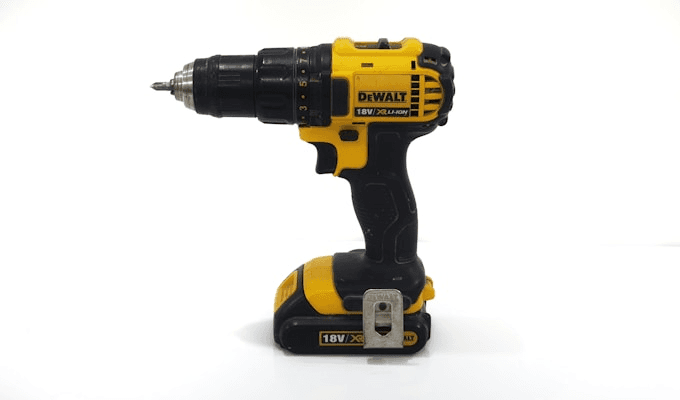
Top Pick: DeWalt DCD999B 20V MAX ATOMIC Brushless Drill
The DCD999B is DeWalt's current flagship 20V brushless drill, and it earns that status. It delivers up to 1,200 UWO of power -- the most in DeWalt's 20V drill lineup -- with a three-speed transmission that gives you genuine low-speed torque for mixing and drilling, mid-speed precision for hardware, and high-speed efficiency for pilot holes. The Tool Connect compatibility is a bonus if you're managing a larger tool inventory. At $199 (tool only), it's on the premium side, but this is a tool that runs for years without complaint. It's also fully compatible with every 20V MAX battery in the DeWalt system.
Check price on Amazon -- DeWalt DCD999B
See our full breakdown in the best cordless drills of 2026 guide.
5. Jigsaw -- For Notches, Stair Stringers, and Curves
A jigsaw is the tool most people forget to budget for -- and then desperately need mid-project. On a standard rectangular deck it sees limited use. The moment you add stairs, posts with notched bases, or any kind of curved or decorative detail, it becomes indispensable.
The key jobs a jigsaw handles on a deck build that nothing else can:
- Notching around posts: When deck boards run into a corner post, you need to notch the board to fit around it. A circular saw can get close but can't finish a notch -- the blade overruns the corner. A jigsaw does it cleanly.
- Stair stringers: Stair stringers require a series of right-angle notches cut into a 2x12. You rough-cut with a circular saw and finish each corner with a jigsaw to avoid overcutting the tread seat. Over-cutting a stringer notch weakens it structurally -- this matters.
- Curved rails and trim: Any decorative curved railing, scalloped skirt board, or shaped fascia detail gets cut with a jigsaw.
- In-place cuts: When something needs to be trimmed in position and a circular saw can't get into the space, a jigsaw with an appropriate blade usually can.
For deck work, orbital action and variable speed are the features worth having. Orbital action (where the blade also moves slightly forward on the cutting stroke) speeds up cuts in thick lumber. Variable speed lets you slow down for tight curves without losing control.
Top Pick: DeWalt DCS334B 20V MAX Jigsaw
The DCS334B is a brushless, keyless jigsaw with four orbital settings, variable speed, and an all-metal keyless blade clamp that makes blade changes fast without a tool. The LED light is genuinely useful for inside cuts in shadowed framing bays. It accepts both T-shank and U-shank blades, and the bevel cuts to 45 degrees for angled work. At $129, it's a clean value in the 20V MAX ecosystem -- it will handle everything a deck project throws at it without being overkill.
Check price on Amazon -- DeWalt DCS334B
See more options in our best jigsaws of 2026 roundup.
6. Random Orbital Sander -- For Rail Caps, Stair Treads, and Finish Work
Every deck has surfaces that will be touched by human hands -- rail caps, stair treads, any exposed horizontal decking edge that didn't get a clean factory finish. Pressure-treated lumber in particular needs attention before staining: the treatment process often raises the grain, and PT boards can have mill marks and surface irregularities that hold stain unevenly if you don't knock them down first.
A random orbital sander handles this work quickly and without leaving the swirl marks that a belt sander or pad sander will leave in cross-grain directions. The random orbital pattern means you can sand with the grain, against it, or at any angle and the finish will still read clean.
For outdoor deck work, here's the grit progression that works:
- 80-grit first pass: Removes mill marks, raised grain, and any rough spots from cutting.
- 120-grit second pass: Smooths the surface to an even finish that will accept stain or sealer uniformly.
- For hardwoods or composite cap boards: A final pass at 150-grit before staining gives a noticeably cleaner result.
You don't need to sand every deck board -- just the ones people will see and touch. Rail caps, top rails, stair treads, and visible fascia are the priority surfaces.
Top Pick: DeWalt DCW210B 20V MAX Random Orbital Sander
The DCW210B is a 5-inch brushless random orbital sander that runs on the same 20V MAX batteries as the rest of this list. Cordless is a genuine advantage here -- you're moving around a finished deck structure sanding handrail caps and stair treads, and a cord gets in the way. The variable speed dial goes from 8,000 to 12,000 OPM, giving you control over cut rate on different materials. The dust-sealed switch and rubber grip hold up to outdoor conditions. At around $79 tool-only, it's the most affordable item on this list and earns its place on every deck job I've finished.
Check price on Amazon -- DeWalt DCW210B
Read our full best random orbital sanders of 2026 guide for all tested options.
Tools You Don't Need for a Residential Deck
Plenty of tool guides for deck building include things that look impressive but don't actually belong on a typical residential job. Here's what to skip:
- Table saw: You're not ripping hundreds of boards to custom width. Every piece of lumber you buy comes from the mill at a standard dimension. The one or two rips you actually need to make (say, a partial-width board at the house wall) can be done accurately with a circular saw and a rip guide. A table saw is heavy, requires setup space, and adds zero efficiency to a deck build.
- Track saw: Great tool. Not needed here. A circular saw with a straightedge clamped to the board does the same job for deck work at a fraction of the cost.
- Framing nailer: This one surprises people. Pneumatic framing nailers are fast for sheathing and stud walls, but deck framing is dominated by hardware -- post caps, joist hangers, angle brackets, and beam hangers -- all of which require screws or bolts, not nails. Joist hanger nails are the exception, but that's a small hammer job, not worth the compressor and hose. Structural screws driven by your impact driver do the job at least as well and are actually easier to remove if you make a mistake.
- Reciprocating saw: Useful in demolition and plumbing rough-in, but for new deck construction it has almost no role. If you're removing an old deck before building a new one, borrow one for a day. Don't buy it for this project.
The tools you need are the six above. Everything else is a purchase you'll regret when you're unloading it from your car and looking for somewhere to put it.
Battery Platform Strategy: Don't Split Your Ecosystem
If you're buying multiple tools for this project, the single best financial decision you can make is committing to one battery platform before you buy anything. Here's the math.
A 20V MAX DeWalt battery -- a 5.0Ah pack, the size you want for power tools under load -- retails for around $79-99. Buy five tools on five different platforms and you're buying five separate batteries. Buy five tools on one platform and you buy two or three batteries that work across all of them.
Two platforms are worth considering for a deck-scale tool purchase:
- DeWalt 20V MAX: The largest battery ecosystem in North America. Every tool on this list except the Milwaukee impact driver runs on it. If you prioritize ecosystem coherence, going all-DeWalt makes sense. A DeWalt 20V MAX 2-battery starter kit runs around $150-180 and will power all five compatible tools on this list.
- Milwaukee M18: Milwaukee's M18 platform is the professional standard on many commercial job sites, and the 2853-20 impact driver is genuinely the best in its class. If you're already in the M18 system or planning to build out a larger tool set over time, anchoring on Milwaukee makes sense. You'd pair it with Milwaukee M18 versions of the drill, circular saw, and jigsaw.
If you're starting from zero and buying everything new for this project, the pragmatic call is to go all-DeWalt 20V MAX. The ecosystem is deep, the tools are readily available, and you can sell them or build on them after the deck is done. Estimated tool-only cost for the full DeWalt lineup above: approximately $675 before batteries. Add two 5.0Ah batteries and a dual charger for around $200, and you have a complete platform for around $875 total -- a reasonable outlay for tools that will outlast multiple projects.
If the Milwaukee impact driver is non-negotiable for you (it's legitimately best-in-class), run two platforms: Milwaukee M18 for the impact driver and DeWalt 20V MAX for everything else. You'll carry two types of batteries, but both platforms are widely available at every major retailer.
Frequently Asked Questions
What tools do I need to build a deck?
For a standard residential deck, the six tools you need are: a miter saw for precise length cuts, an impact driver for driving screws, a circular saw for ripping boards and field cuts, a drill for pilot holes and hardware, a jigsaw for notches and stair stringer work, and a random orbital sander for finish surfaces. You'll also need hand tools -- a speed square, chalk line, tape measure, and level -- but on the power tool side, that list covers everything a typical deck build requires.
Can I build a deck with just a circular saw?
Technically yes, but it's the hard way. A circular saw can make most of the cuts a deck requires, but crosscutting boards to exact identical lengths accurately is much slower and less consistent without a miter saw. If you're building a small deck on a very tight budget and already own a circular saw, you can make it work -- use a speed square as a guide for square crosscuts and a rip guide for length cuts on the same measurement. But if you're buying tools specifically for this project, add the miter saw. The time savings on repetitive crosscuts pay for it quickly.
Is a miter saw necessary for deck building?
Not strictly necessary, but strongly recommended. A miter saw gives you consistent, repeatable crosscuts at accurate angles -- essential when you're cutting 80 deck boards to the same length, or cutting railing balusters to identical heights. The alternative is clamping a speed square or straightedge to every board and cutting with a circular saw, which works but is slower and prone to accumulated error. For a one-time small deck build, you can rent a miter saw for around $40-60 per day from any tool rental outlet rather than buying. For anything larger, buy it -- you'll use it on every project after this one.
How long does it take to build a deck?
A standard 12x16 pressure-treated deck -- footings, framing, decking, stairs, and basic railing -- takes most experienced DIYers with proper tools about 3-4 weekends of full-day work, or roughly 50-80 hours total. That assumes permits are in hand before you start and materials are staged. Your first deck will take longer than your second. The framing phase is usually faster than people expect; the finish work -- cutting deck boards to length, fitting railing, trimming stairs -- is where the time goes. Factor in at least one trip back to the lumber yard, one day waiting for concrete footings to cure, and one afternoon hunting for a lag bolt you set down somewhere.